
Tsothel (Zuotai): The Crown Jewel of Tibetan Medicine
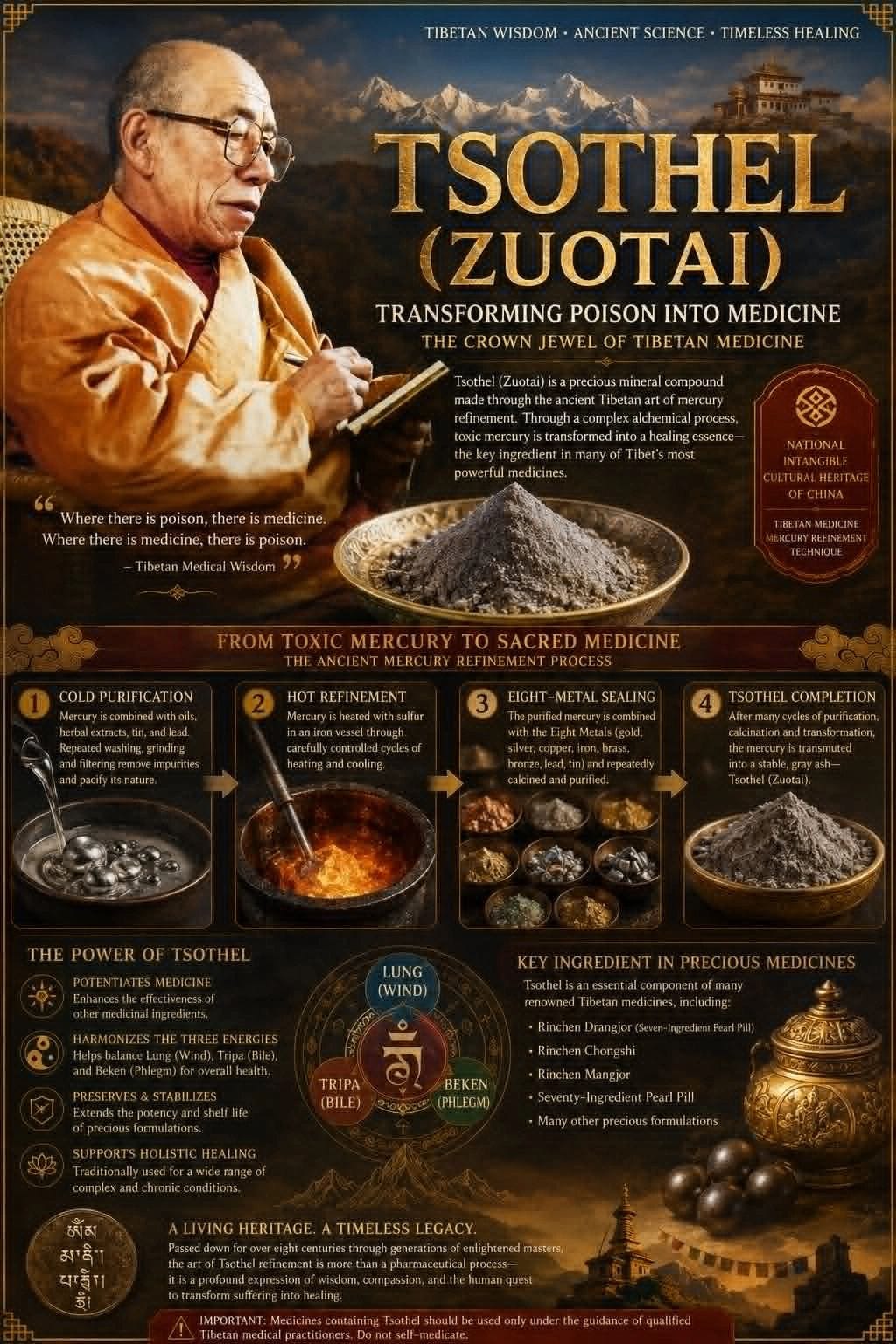
Tsothel (Zuotai): The Crown Jewel of Tibetan Medicine
For more than eight centuries, Tibetan physicians have preserved a remarkable alchemical tradition that transforms one of nature’s most toxic substances into one of their most treasured medicinal ingredients. Known as Tsothel (Zuotai), this sacred compound lies at the heart of Tibet’s famous Precious Jewel Medicines and represents one of the most sophisticated pharmaceutical processes in traditional medicine.
Rooted within the broader Tibetan medical system of Sowa Rigpa, which has flourished for over 1,200 years, Tsothel is created through an intricate process of mercury purification, mineral refinement, and multi-stage alchemical transformation. Revered as the “King of Medicines” and the “Crown Jewel of Tibetan Pharmacy,” it embodies the Tibetan medical principle that wisdom, skill, and knowledge can transform poison into medicine.
Passed down through generations of master physicians and alchemical practitioners, Tsothel remains a living symbol of Tibetan healing science, cultural heritage, and humanity’s enduring quest to understand the hidden healing potential within nature. In this article, we explore the fascinating history of Tsothel, the legendary masters who preserved its secrets, the extraordinary process behind its creation, and its enduring place within one of the world’s oldest living medical traditions.
Tsothel (Zuotai): The Crown Jewel of Tibetan Medicine — Transforming Poison into Medicine Through Ancient Alchemical Wisdom
Introduction
Among the world’s great traditional medical systems, Tibetan Medicine stands out as one of the most sophisticated and holistic healing traditions. Rooted in over two thousand years of accumulated knowledge, it integrates medicine, spirituality, astronomy, psychology, mineralogy, and ecology into a unified understanding of health.
At the very heart of Tibetan pharmaceutical science lies one of its most revered and mysterious substances:
Tsothel (Tibetan: གཙོ་ཐལ་, pronounced gTso-thal), known in Chinese as 佐太 (Zuotai).
Often called:
The King of Medicines
The Jewel of Tibetan Pharmacology
The Mother of Precious Pills
The Nectar Essence of Healing
Tsothel is perhaps one of the most fascinating examples of humanity’s attempt to transform what is harmful into something beneficial. Through an elaborate alchemical process known as the Mercury Detoxification and Refinement Method, Tibetan physicians developed a way to convert raw mercury—one of nature’s most toxic substances—into the central ingredient of some of the most treasured medicines in the Tibetan pharmacopeia.
This extraordinary process has been recognized as part of China’s National Intangible Cultural Heritage, preserving a living tradition that continues to inspire researchers, physicians, and historians alike.
The Tibetan Philosophy of Medicine and Poison
One of the foundational principles of Tibetan medicine states:
“Where there is poison, there is medicine.
Where there is medicine, there is poison.”
This principle reflects a profound understanding of nature.
Nothing in existence is inherently good or bad.
Everything possesses qualities that can heal or harm depending upon:
Preparation
Dosage
Timing
Context
Knowledge of use
In Tibetan medicine, disease is often understood as an imbalance of energies and elements. Substances that appear dangerous may contain powerful healing potential when properly transformed.
Tsothel represents perhaps the most dramatic expression of this philosophy.
What Exactly Is Tsothel?
The Tibetan word gTso-thal roughly translates as:
gTso = principal, supreme, chief
thal = ash or calcined powder
Thus Tsothel can be interpreted as:
“The Supreme Refined Ash”
or
“The Principal Calcined Essence.”
It is not a single herb, mineral, or metal.
Rather, it is a highly complex alchemical compound produced through months of purification, grinding, heating, cooling, combining, and ritual preparation.
Once completed, Tsothel becomes the key ingredient in many of Tibet’s most famous Precious Jewel Medicines(Rinchen Rilbu).
Without Tsothel, many of these medicines would not be considered complete.
Origins in the Four Medical Tantras
The earliest foundations of Tsothel preparation can be traced to the legendary Tibetan medical text:
The Four Medical Tantras (Gyüshi)
Compiled around the 8th century CE and traditionally attributed to the physician-scholar:
Yuthok Yonten Gonpo
The Four Medical Tantras became the cornerstone of Tibetan medical education.
These texts describe:
Anatomy
Physiology
Diagnosis
Herbal medicine
Mineral medicine
Therapeutic procedures
Among these teachings are references to mercury purification and mineral transformation.
The Great Alchemical Masters
During the 13th century, Tibetan master physician and alchemist:
Orgyen Rinchen Pal
developed one of the earliest complete systems for mercury purification and Tsothel production.
He documented these methods in works such as:
The Treatise on Tsothel Refinement
These texts established the detailed procedures that would later become the standard for Tibetan pharmaceutical alchemy.
Subsequent generations of renowned Tibetan physicians continued refining the process, including:
Rangjung Dorje
Nyenni Dorje
Kongtrul Yonten Gyatso
Tsarong Tsultrim
and many others.
For centuries, the knowledge was transmitted secretly from master to disciple.
Only a small number of practitioners possessed the complete method.
The Near Loss and Revival of Tsothel
Like many ancient traditions, Tsothel production nearly disappeared during the social upheavals of the twentieth century.
By the mid-1900s, only a handful of masters retained the full knowledge of the process.
Fortunately, in the late 1970s, efforts were undertaken to recover and preserve this precious heritage.
One of the most important figures in this revival was:
Master Tsoru Tsering (Cuo Ru Cailang)
Through painstaking reconstruction of the traditional methods, supported by Tibetan medical institutions and government programs, the art of Tsothel production was successfully revived.
Today, the process survives through Tibetan medical colleges, hospitals, and pharmaceutical institutes.
The Mysterious Mercury Refinement Process
The creation of Tsothel is one of the most elaborate pharmaceutical procedures found anywhere in traditional medicine.
The process can require:
Several months of work
Dozens of ingredients
Hundreds of individual steps
Continuous supervision by trained specialists
Traditional preparation consists of several major phases.
Stage One: Cold Purification
Raw mercury is combined with substances such as:
Vegetable oils
Butter
Tin
Lead
Medicinal extracts
The mixture is repeatedly:
Ground
Washed
Filtered
Triturated
This process removes impurities while altering the physical characteristics of the mercury.
The purification may continue for weeks.
Stage Two: Hot Refinement
The mercury then undergoes controlled heating.
Sulfur is added, producing complex chemical reactions.
Repeated cycles of heating and cooling are used to stabilize the material.
In traditional Tibetan terminology, this process helps “tame” the volatile nature of mercury.
Stage Three: The Eight-Metal Sealing Process
One of the most fascinating aspects of Tsothel production involves combining mercury with the so-called:
Eight Metals
Traditionally including:
Gold
Silver
Copper
Iron
Bronze
Brass
Lead
Tin
These metals are carefully processed into ash-like forms and combined through intricate procedures.
According to Tibetan theory, these substances help:
Neutralize toxicity
Stabilize energetic qualities
Enhance medicinal potency
The result is a highly complex mineral compound unlike any single ingredient from which it originated.
Is Tsothel Still Mercury?
This question is at the center of modern scientific discussion.
From a traditional Tibetan perspective:
Tsothel is no longer ordinary mercury.
After extensive purification and transformation, it is considered an entirely new medicinal substance.
Modern analytical studies have shown that Tsothel contains complex mercury compounds rather than elemental liquid mercury alone.
Researchers have identified various mineral forms resulting from the traditional preparation process.
However, scientific debate continues regarding:
Toxicity
Bioavailability
Long-term safety
Pharmacological mechanisms
Because Tsothel contains mercury-derived compounds, modern experts generally recommend that any Tsothel-containing medicine be used only under the guidance of qualified practitioners.
Why Is Tsothel So Important?
In Tibetan medicine, Tsothel serves several unique functions.
1. Potentiator of Other Medicines
Tsothel is often described as a catalyst.
Rather than acting alone, it enhances the effectiveness of other medicinal ingredients.
For this reason it is frequently referred to as:
“The guide that leads all medicines.”
2. Harmonizer of the Three Energies
Tibetan medicine recognizes three fundamental physiological principles:
Lung (Wind)
Associated with:
Movement
Nervous system function
Mental activity
Tripa (Bile)
Associated with:
Heat
Digestion
Metabolism
Beken (Phlegm)
Associated with:
Stability
Structure
Fluids
Disease arises when these become imbalanced.
Traditional Tibetan physicians believe Tsothel helps restore harmony among all three.
3. Preservation of Medicine
Tsothel is also believed to extend the stability and shelf life of precious medicines.
Many classical formulations containing Tsothel remain usable for decades when properly stored.
4. Precious Pill Formulations
Tsothel is an essential ingredient in many renowned Tibetan medicines, including:
Rinchen Drangjor
Rinchen Mangjor
Seventy-Ingredient Pearl Pill
Rinchen Chongshi
These formulations are traditionally prescribed for complex and chronic conditions.
Beyond Medicine: A Symbol of Transformation
Perhaps the greatest significance of Tsothel is symbolic.
It represents humanity’s enduring quest to transform:
Disorder into harmony
Illness into health
Ignorance into wisdom
Poison into medicine
The Tsothel process is not merely pharmaceutical.
It is also philosophical.
It reflects a worldview in which nothing is permanently fixed.
Even the most dangerous substance can become beneficial when approached with sufficient understanding, discipline, and respect.
Tsothel and Modern Research
Today, scientists continue studying Tsothel using:
Electron microscopy
Spectroscopy
Toxicology testing
Pharmacological analysis
Researchers hope to better understand:
Its chemical composition
Traditional detoxification mechanisms
Potential therapeutic applications
Safety standards
This ongoing dialogue between ancient wisdom and modern science may offer valuable insights into the future of integrative medicine.
Conclusion
For more than eight centuries, Tsothel has occupied a unique place in the history of medicine.
Created through one of the world’s most sophisticated traditional alchemical processes, it embodies the Tibetan medical understanding that healing often arises through transformation rather than elimination.
Whether viewed as a pharmaceutical marvel, a cultural treasure, a spiritual symbol, or a subject of scientific investigation, Tsothel remains one of the most fascinating achievements of Tibetan civilization.
Its story reminds us that true wisdom often lies not in rejecting what appears dangerous, but in learning how to transform it with knowledge, patience, and respect.
Tsothel is more than a medicine. It is a living testament to the Tibetan vision that even poison can become nectar when guided by wisdom.